Annalise’s Bared Shoes
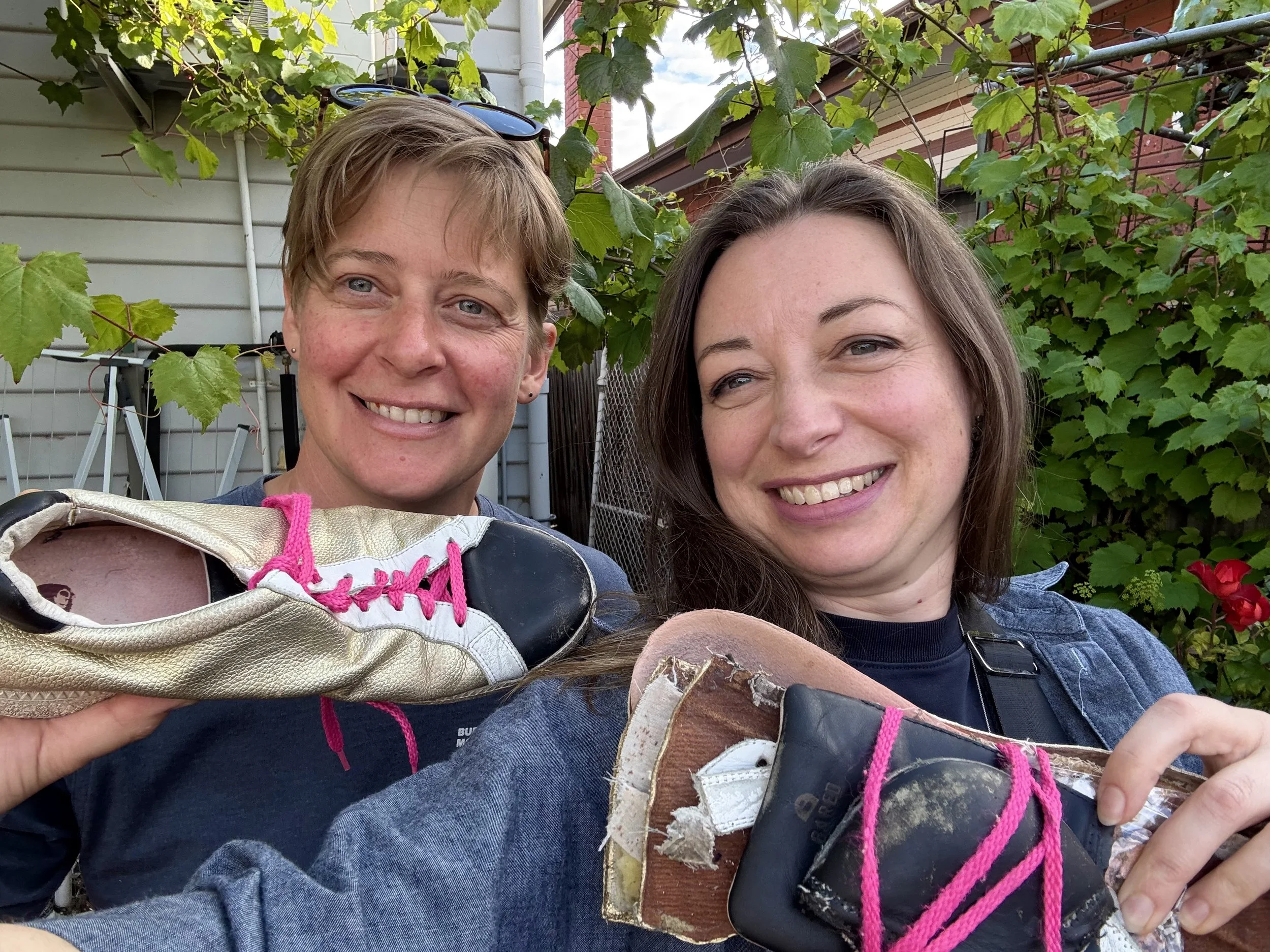
From Left: Annalise and Alex with Annalise’s donated pair of Bared shoes in original and deconstructed form. Photo: Alexandra Sherlock, 2025.
What is the origin of your shoes?
Whose are they? When, where and how were they acquired? If yours, what drew you to them?
These shoes were made by Bared and purchased in 2018 by Annalise, a Brunswick resident and primary school teacher who responded to my request for old shoes that were beyond repair via the Merribek Hard Rubbish Rescue Facebook group. My teaching and research collaborator, Pennie Jagiello, and I designed an activity for Fashion Design Students at RMIT University to encourage material literacy, creativity, innovation, and circular design principles by deconstructing old shoes and reconstructing them into body-worn artefacts and accessories. Annalise’s shoes weren't used by the students. I'm unsure if I subconsciously held them back because I loved them so much, or they just weren't chosen, perhaps due to how degraded and dirty they were.
What have they done?
What places, moments, people or phases of life have they become associated with?
Beyond their worn life with Annalise, the shoes have been on quite a journey! I deconstructed the left shoe in 2025 and featured it as a flat-lay artwork at Melbourne Fashion Week in an exhibition titled Uncertain Endings, curated by colleagues Julia English and Remie Cibis. In conjunction with the exhibit, which also featured a deconstructed UGG boot made into a necklace and earrings by Pennie and a hat by me, we ran a deconstruction workshop for participants. This led to an invitation to evolve the project into a larger exhibition and full-day workshop at the PayPal Melbourne Fashion Festival 2026, where Pennie has since reconstructed the shoe into an astonishing range of accessories. They now form the centrepiece of this event and are featured on all visual communications. After seeing the flat-lay shoe at Melbourne Fashion Week, we were delighted to be contacted by the Sustainability Manager at Bared Footwear, whose headquarters are in Melbourne, to discuss how the brand might engage with and support our work.
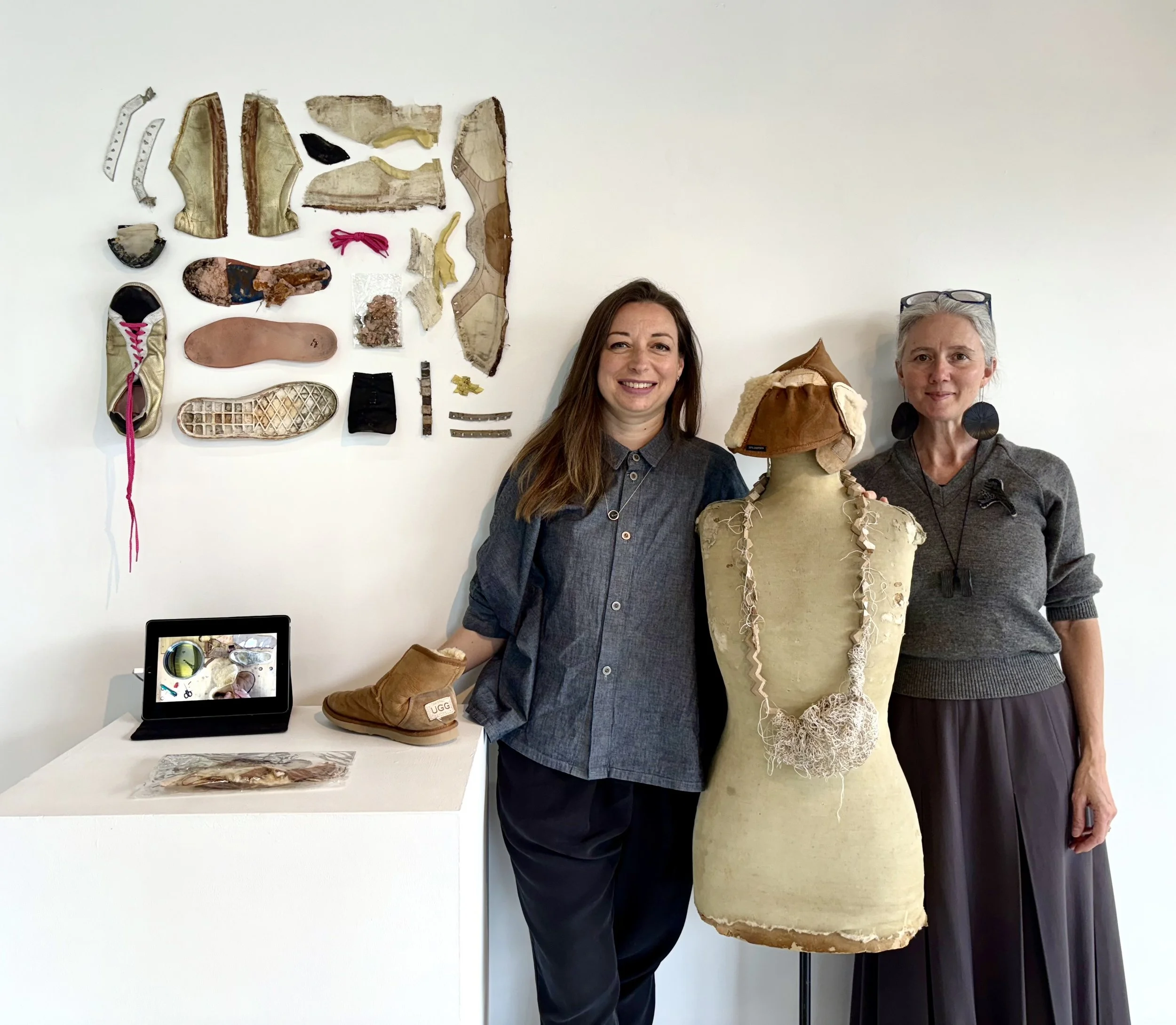
Alex and Pennie at the ‘Uncertain Endings’ exhibition, curated by Julia English and Remie Cibis as part of the 2025 Melbourne Fashion Festival. Photograph by Julia English, 2025.
What do they signify?
What do they represent or symbolise? What memories or feelings do they hold?
These shoes represent the evolution of the 'This is not a shoe' project, from the early days to today. They also represent the development of a wonderful collaboration between Pennie and me, and the growing interest the project has attracted from the general public and the footwear industry. We strongly believe that the only way to engage people in conversations about sustainability and circularity is not through shame, but by framing circularity as a creative and rewarding opportunity to inspire conscious consumption, design, and production practices. I love how intrigued people are by the deconstructed shoes and their transformations, and I'm excited to see what innovations could emerge from deeper reflection on what happens to our worn items at the end of their conventional life. Throughout their afterlife, the shoes have afforded valued friendships with Pennie and their original owner, Annalise, with whom I remain in contact. I enjoy updating Annalise on the shoes’ latest adventures.
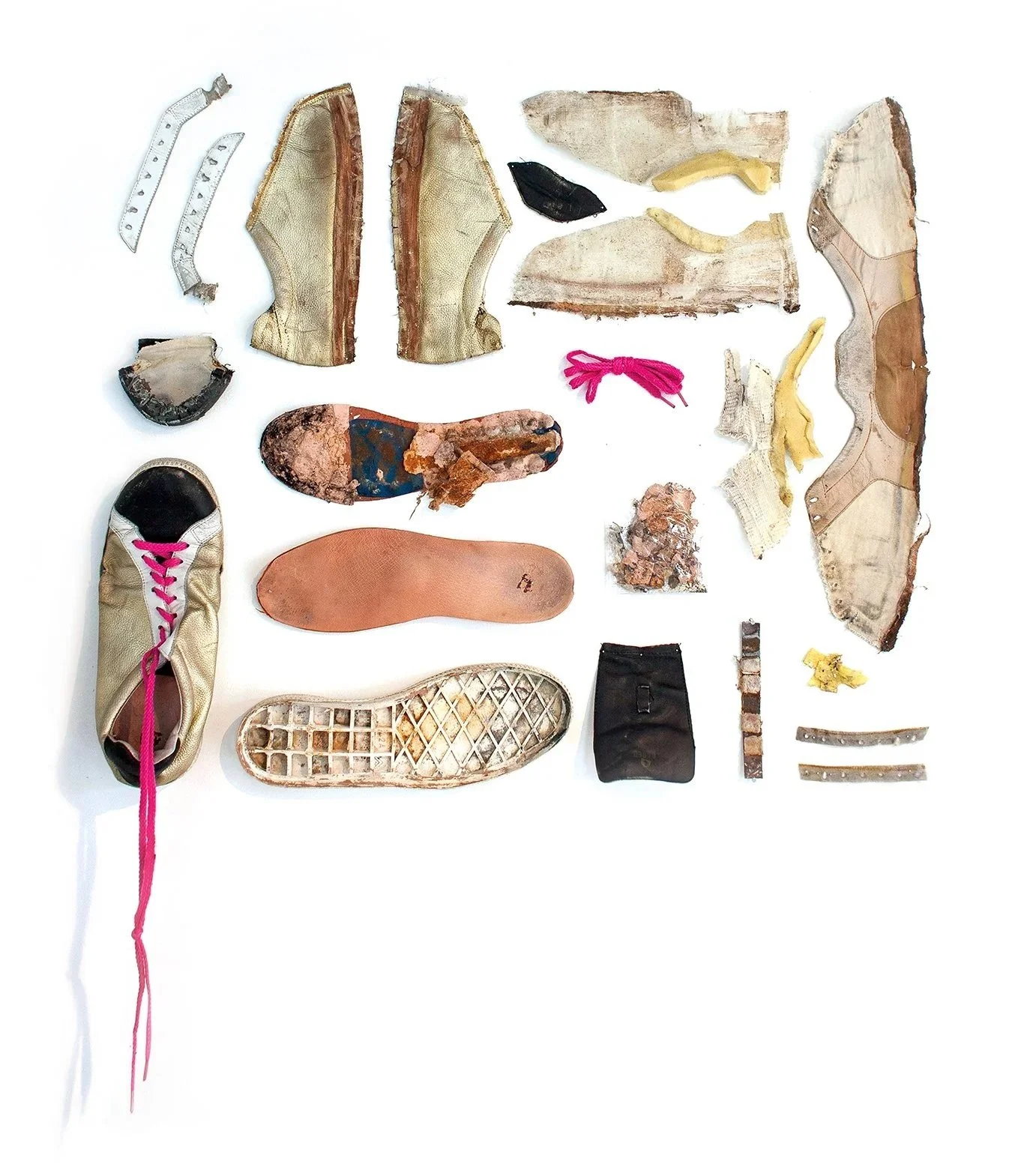
Annalise’s deconstructed Bared shoe by Alex Sherlock. Photograph by Julia English, 2025.
What did/do you love about them?
A particular material, colour, shape, detail or the way they felt to wear?
I was drawn to the gold uppers and the pink laces, which I later learned were a customisation by Annalise after the original laces broke. While chatting, we reflected on the materials she liked, including the soft leather lining at the back of the shoe, which she enjoyed the feel of and was a driving factor for the purchase. This made me reflect on which materials we do and don't like against our skin, and how our relationships with materials can inform their eventual use and transformation. Her comments inspired me to reconstruct my own sneakers, using the soft leather lining to prevent rubbing from my phone pouch's strap. While reconstructing Annalise’s shoes into accessories, Pennie loved working with the leather, which was soft and malleable, and the patina, which became a feature of the accessories. She was also inspired by the idea that shoes are vessels, not only for the body (the foot) but also for emotions, meaning, and memory. She therefore made many parts of the shoe into individual vessels. I love the fact that these individual objects could be redistributed amongst all those who have had a role in their lives and transformation - forever connecting us. But for now, they will remain together to tell the project's story.
Is there anything you dislike about them?
While deconstructing the shoes, I found their dirtiness a little challenging. I have found the same while deconstructing my own footwear. I washed the pieces before giving them to Pennie, but despite being hygienic now, it is impossible to erase the signs of wear. Shoes are intimate objects, and the bodily and environmental traces, as well as material degradation over time, are barriers to reuse and recycling. I feel like the materials have become less abject through the transformation process, which has purified them, giving them new meaning, value, and significance. I like the way the materials and their transformation challenge the conflation of pristiness with value. For Pennie, the notion that leather is the skin of a once-living animal was important. Carefully suturing the materials symbolically honoured the sacrifice they represent.
What do you think would happen to them if you didn't give them a second life?
These shoes were too far gone to be reused, so I think my call for old shoes provided a solution for their disposal. Other alternatives would have been to deposit them in a Save Our Soles shoe bin (at some shopping centres) for grinding into crumb and downcycling; however, this would have conflicted with the respect we all held for the quality materials used. The extra laces were added by Pennie, who found several bags at an op-shop. We're not sure where they came from, but they are unused, which suggests they may be pre-consumer factory waste. By reusing these laces to join the shoe's pieces, she intended to reflect on the often wasteful processes of a conventionally linear and wasteful manufacturing system. The knotting of the laces is a symbolic gesture to close the loop and ensure material reuse and recirculation.
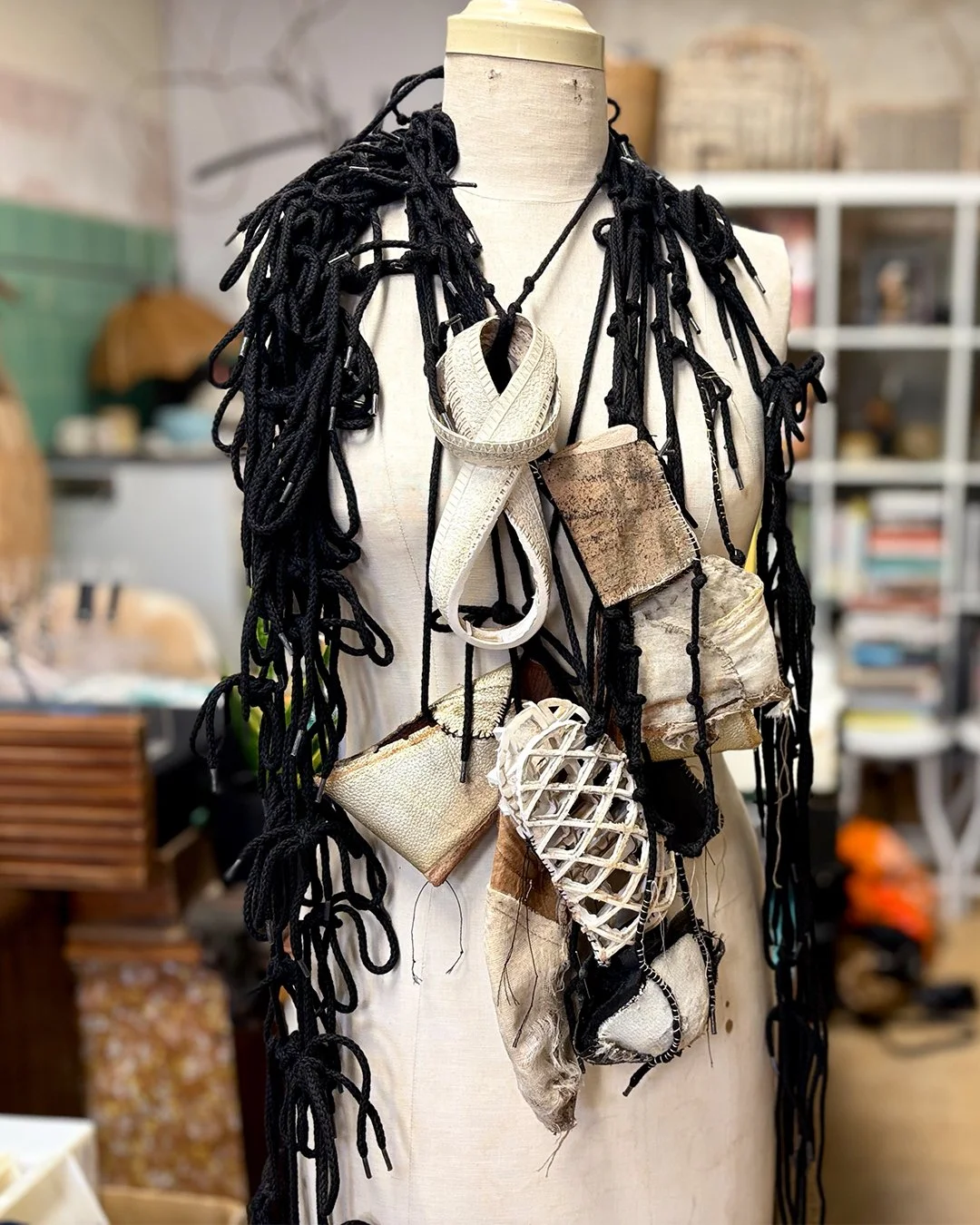
Some of the final accessories constructed from Annalise’s Bared shoe, by Pennie Jagiello, 2025. Photograph by Alex Sherlock.